
Introduction
Group buy deals show up in every hosting community: one person buys a powerful server or plan, splits the cost among strangers, and everyone gets premium specs for a fraction of the price. On paper, it looks like free money.
In practice, group buy VPS arrangements fail in ways individual purchases never do. Some buyers lose their data overnight. Others watch the shared IP get blacklisted because of a neighbor’s spam. This article explains how the model works, where it breaks, and when sharing is actually safe.
What Is a Group Buy VPS?
The model is simple. An organizer purchases a VPS plan or a dedicated server, then sells slots to other users to cover the cost. Each participant receives some form of access: a full virtual machine, a container, or just an account on the organizer’s panel.
Three common variants exist:
- A resold plan, where the organizer’s account hosts everyone;
- A container split, where each buyer gets an isolated container on one server;
- A promo-stacked purchase, where the organizer exploits trial credits or stacked discounts and resells the capacity.
The first and third variants are the risky ones. The second can be legitimate, depending on execution.
Why the Price Looks So Good
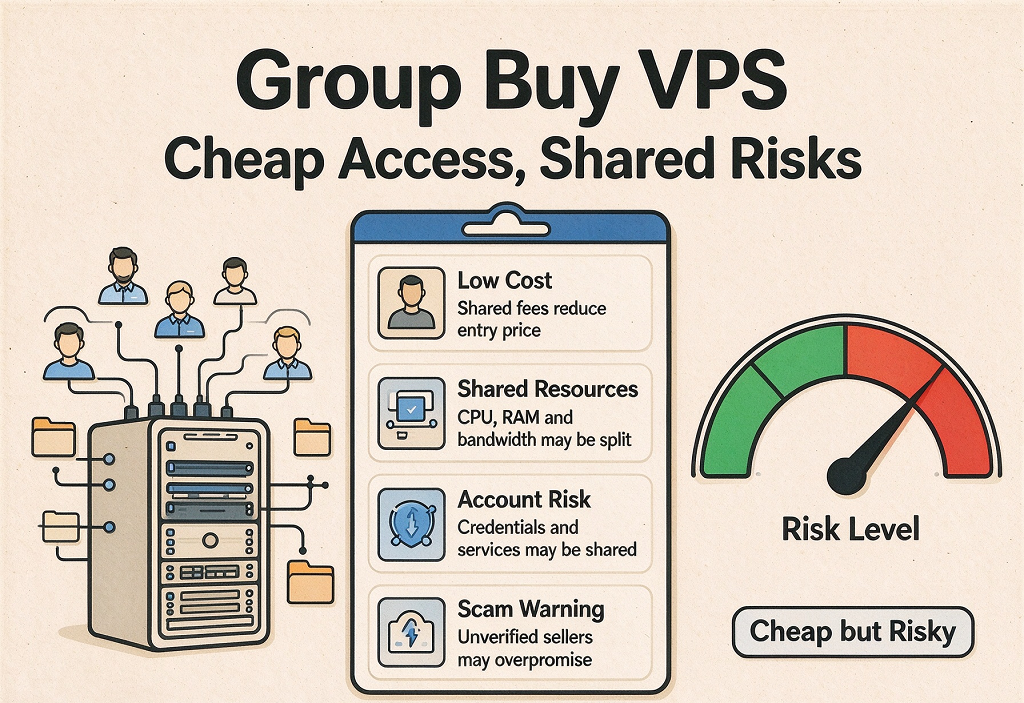
The economics are simple: a $120 dedicated server split ten ways costs $12 per person. For buyers who cannot afford premium specs alone, the math is tempting.
Sometimes the discount comes from somewhere darker. Some organizers stack trial credits, abuse new-customer promotions, or use stolen payment methods. When the underlying purchase collapses, every participant loses access at the same moment.
The Real Risks
You do not control the account. The organizer holds the panel, the billing relationship, and the provider relationship. Your data lives on infrastructure you cannot manage. If the organizer disappears, disputes with other buyers, or simply loses interest, your access ends with them.
Resource contention is guaranteed. Group buys often oversell beyond what the server can handle. One neighbor running a crypto miner or a heavy scraper degrades everyone’s performance, and you have no authority to stop them.
Shared IPs carry shared reputations. This is the risk buyers underestimate most. If one participant sends spam or runs abusive scripts, the shared IP lands on blacklists. Your legitimate projects suffer alongside theirs, and delisting requires the account holder to act.
It usually violates the provider’s terms. Most providers prohibit sharing or reselling a plan. When they detect it, the entire service can be suspended for everyone, including buyers who behaved perfectly.
There is no SLA and no support. The provider only knows the organizer. As an anonymous participant, you have no ticket channel, no uptime guarantee, and no recourse beyond asking a stranger to fix things.
Payment flows are informal. Money typically moves through personal payment channels with no invoices and no protection. Combined with anonymous organizers, chargeback fraud and outright scams become practical possibilities.
When Sharing Actually Works
Sharing is not always a scam. It works reasonably well under three conditions:
- The participants know each other, or at least operate under written rules;
- Each person gets a properly isolated virtual machine or container, not a shared account;
- The provider’s terms allow it, or the group uses one account per person on the same infrastructure.
A small team splitting a dedicated server with real virtualization is a legitimate setup. A stranger in a Telegram group selling “1GB RAM slots for $2” is not the same thing, no matter how similar the description sounds.
The Smarter Alternative: One Promo VPS Per Person
Here is the part most group buy participants miss. During major sales, the price gap between a group buy share and a legitimate entry VPS nearly disappears.
Entry-level annual plans from reputable providers often drop to around $10 to $20 during Black Friday and similar events. That is roughly what a group buy slot costs — except you get your own account, your own IP, your own support channel, and actual terms of service.
Timing matters more than bargaining power. For Black Friday specifically, kenny translated and reposted the article “Black Friday Is One Month Away — Which Providers Are You Camping This Year?”, comparing past-years Black Friday plays from major providers like BandwagonHost, DMIT, RackNerd, VMRack, and HostDare. If you want to evaluate unmetered or unlimited offers, read KayVPS’s article “How to Spot a Real Unmetered VPS Deal (And Avoid the Fake Ones)”.
One legitimate VPS during a sale beats ten group buy shares, because the cheapest thing in hosting is not a shared plan. It is a personal plan bought at the right time.
Conclusion
Group buy VPS deals trade real control for a small discount. The account belongs to someone else, the IP belongs to everyone, the terms of service usually object, and the compensation for failure is zero.
If the participants are trusted, the isolation is real, and the provider allows it, sharing can work. If any of those three conditions is missing, the money you save is not a discount. It is your deposit on someone else’s risk.
Thanks for reading to the end!